Mastering Fluid Dynamics: Centrifugal vs. Positive Displacement Pumps in Qatar
Introduction: The Science of Moving Liquid
In the hyper-industrialized landscape of Qatar, managing the flow of liquid is the absolute foundation of survival. Whether you are pumping freezing 6°C chilled water up to the 80th floor of a commercial skyscraper in West Bay, or meticulously injecting highly concentrated, corrosive anti-scaling acid into a massive municipal desalination plant, the mechanical heart of the operation is the Industrial Pump.
A catastrophic mistake made by inexperienced engineers is assuming that “a pump is just a pump.” They simply look at the required Gallons Per Minute (GPM) and purchase the cheapest pump available.
This is a dangerous engineering failure. Different liquids have completely different physical properties (like viscosity, density, and chemical aggression). Forcing thick, heavy crude oil or aggressive chemicals through the wrong type of pump will instantly violently destroy the internal mechanics, leading to massive toxic leaks, ruined electric motors, and millions of Riyals in downtime.
Choosing the right industrial pump supplier in Qatar ensures you receive the exact fluid dynamic specifications your pipeline requires. At Autonex, we supply world-class, heavily engineered pumps for the most brutal applications on earth. In this comprehensive guide, we will break down the two primary kingdoms of fluid dynamics: The Centrifugal Pump and the Positive Displacement (PD) Pump.
The Centrifugal Pump: The Master of Volume
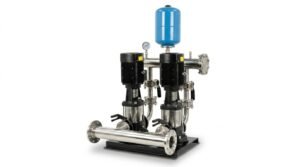
If you look at the massive chilled water (CHW) pumps in a hotel basement, the colossal fire pumps, or the massive municipal lift stations, 95% of them are Centrifugal Pumps.
How a Centrifugal Pump Works
The mechanics of a centrifugal pump are based purely on velocity and kinetic energy. Inside the massive cast-iron or stainless-steel casing (the volute) is a rapidly spinning metal disc covered in curved blades, known as the Impeller.
The electric motor violently spins this impeller at high speed (often 3,000 RPM). Water is sucked into the center (the eye) of the spinning impeller. The curved blades violently grab the water and throw it outward against the walls of the casing using extreme centrifugal force. This violent outward throw creates a massive low-pressure vacuum in the center, which sucks more water in, creating a continuous, massive flow.
The Absolute Strengths
- Colossal Volume: Centrifugal pumps are the absolute kings of moving massive amounts of water. If you need to flood a massive cooling tower with 5,000 Gallons Per Minute, this is the only pump that can do it efficiently.
- Low Maintenance: Because the impeller never actually physically touches the outer casing of the pump, there is virtually zero internal metal-on-metal friction. A well-aligned centrifugal pump can run 24 hours a day for decades with only basic bearing lubrication.
- Variable Speed: They pair perfectly with Variable Frequency Drives (VFDs). You can smoothly slow the pump down to save massive amounts of electricity without damaging the motor.
The Fatal Weakness (Viscosity)
A centrifugal pump relies entirely on the liquid being thin and easily throwable (like water). If you try to pump something incredibly thick and sticky—like heavy crude oil, thick mud, or liquid molasses—the thick liquid simply sticks to the spinning impeller. The impeller will spin uselessly, drawing massive amounts of electricity, but the thick liquid will refuse to move.
The Positive Displacement (PD) Pump: The Master of Precision and Viscosity
When you need to move incredibly thick fluids, or you need to move a microscopic, mathematically precise amount of fluid, you must completely abandon centrifugal force and use a Positive Displacement (PD) Pump.
How a PD Pump Works
Instead of throwing water with velocity, a PD pump uses pure, brute-force mechanical trapping. It physically traps a specific, mathematically exact volume of liquid inside a sealed mechanical chamber, and then physically forces that liquid out into the discharge pipe using massive mechanical pressure.
There are many types of PD pumps (Gear pumps, Piston pumps, Diaphragm pumps), but they all follow the same rule: for every single rotation of the motor, the exact same volume of liquid is violently shoved out, regardless of the pressure in the pipe.
The Ultimate Dosing Pump
In a massive cooling tower or desalination plant, you must inject highly concentrated, extremely toxic biocides and acids into the water to kill bacteria. You cannot guess the volume. If you inject too much, you poison the water; if you inject too little, deadly Legionella bacteria will breed.
Autonex supplies highly advanced PD Chemical Dosing Pumps. These small, incredibly precise pumps use a pulsating diaphragm to physically inject an exact, microscopic drop of acid (often measured in milliliters per hour) directly into the high-pressure water main. Because it is a PD pump, the massive 1,000 PSI pressure in the main pipe physically cannot stop the little dosing pump from forcing the chemical in.
Conquering Heavy Viscosity
If you need to pump thick, heavy industrial sludge or highly viscous crude oil, a massive PD “Gear Pump” is used. Inside the pump, two massive steel gears violently crush together. The thick oil is trapped in the tiny spaces between the gear teeth and the outer wall, and is violently ground forward into the pipe. The thicker the liquid, the better a PD pump actually works.
The Catastrophic Danger: “Dead-Heading”
The fundamental difference in how these two pumps generate pressure creates a vastly different safety profile.
If a lazy operator accidentally closes a massive massive steel isolation valve on the discharge pipe while the pump is running, the pipe is completely blocked. This is called “Dead-Heading” the pump.
- Dead-Heading a Centrifugal Pump: The impeller will continue to spin violently, throwing water against the closed valve. Because the water has nowhere to go, it will stay inside the pump, violently churning. The extreme friction will cause the water to boil within 10 minutes. The boiling water will melt the mechanical seals, but the pipes will generally not explode immediately.
- Dead-Heading a PD Pump (A Massive Explosion): Because a PD pump physically *forces* a specific volume of liquid into the pipe on every single rotation, it does not care if the valve is closed. It will continue forcing liquid into the blocked pipe. Within seconds, the hydrostatic pressure inside the pipe will skyrocket to thousands of PSI. The massive steel pipes will violently rupture and explode like a bomb, spraying toxic chemicals everywhere. PD pumps absolutely must be installed with highly calibrated Mechanical Relief Valves to safely vent the pressure if a blockage occurs.
Frequently Asked Questions (FAQs)
What is “Cavitation” and why does it sound like rocks in the pump?
If a massive centrifugal pump is placed too high above the water tank, it struggles to suck the water up. The intense vacuum suction causes the water inside the pump to literally boil at room temperature, creating microscopic vacuum bubbles. As these bubbles hit the high-pressure side of the spinning impeller, they collapse with the explosive force of a microscopic bomb. This sounds like gravel churning inside the pump. Within weeks, cavitation will violently blast chunks of solid metal right out of the stainless-steel impeller, destroying the pump.
Can a centrifugal pump suck air?
No. Centrifugal pumps are generally not “self-priming.” The massive heavy-metal casing (the volute) must be 100% full of liquid before the motor turns on. If the pump is full of air, the impeller will just spin the air around uselessly, and it will never create enough vacuum to suck the heavy water up into the pipe.
Are PD pumps good for high volume?
No. Because they rely on tight, slow mechanical trapping, PD pumps are terrible at moving massive volumes of liquid. If you need to move 5,000 Gallons Per Minute, you must use a Centrifugal pump. If you need to move 5 Gallons Per Minute at 3,000 PSI, you use a PD pump.
Conclusion: Specify with Absolute Certainty
Fluid dynamics is an unforgiving science. Specifying a massive centrifugal pump for a highly viscous crude oil transfer, or installing a high-pressure PD pump without explosive relief valves, is a guaranteed path to catastrophic mechanical failure, massively expensive downtime, and extreme environmental hazards.
Whether you need colossal, high-volume Split-Case Centrifugal Pumps to feed a massive district cooling plant, or incredibly precise, chemically hardened PD Diaphragm Dosing Pumps to inject toxic acids into a desalination facility, Autonex has the certified inventory and the absolute fluid dynamics mastery to deliver perfection.
Call to Action: Do not gamble your facility’s fluid network on the wrong mechanics. Contact Autonex today, the premier industrial pump supplier in Qatar. Let our specialized engineers analyze your specific viscosity, pressure, and flow requirements to supply the exact, heavily armored pump guaranteed to conquer your application.